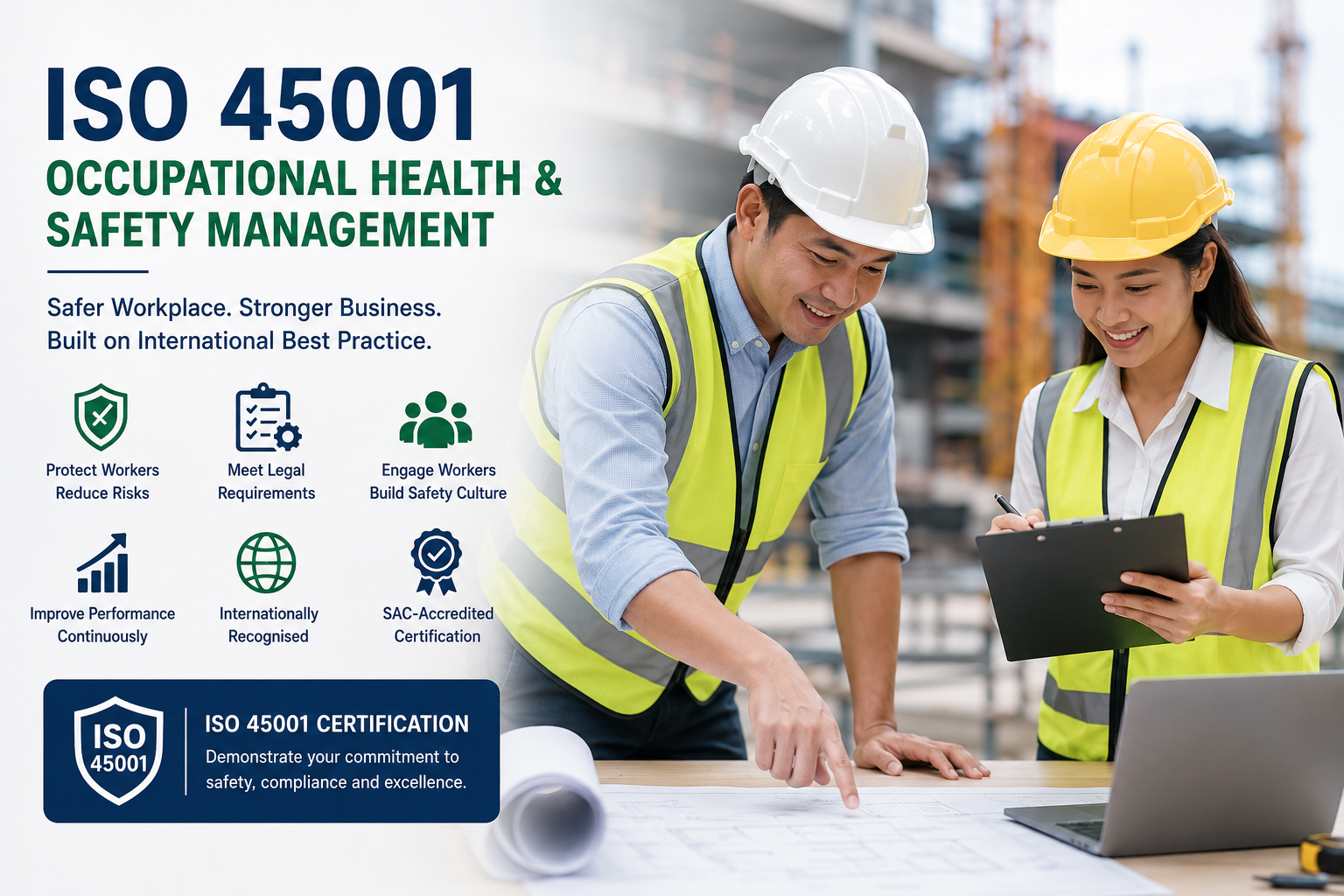

ISO 45001 is the international standard for Occupational Health and Safety Management Systems (OHSMS). For Singapore companies in construction, manufacturing, logistics, marine, and facilities management, ISO 45001 certification demonstrates that your organisation has a structured, independently audited system for protecting workers from harm — and that this system is built to international best practice.
This guide covers everything you need to know about ISO 45001 certification in Singapore: what the standard requires, how the certification process works, how it differs from BizSAFE, and how to choose an SAC-accredited auditor.
What is ISO 45001?
ISO 45001:2018 is published by the International Organisation for Standardisation and replaced the OHSAS 18001 standard, which was officially withdrawn in 2021. Any company still operating under OHSAS 18001 no longer holds a valid certification and should migrate to ISO 45001 as a priority.
ISO 45001 provides a framework for managing occupational health and safety risks and opportunities in a systematic way. It is designed to help organisations:
- Prevent work-related injuries, ill-health, and fatalities
- Provide safe and healthy workplaces for workers and visitors
- Proactively improve OH&S performance over time
- Fulfil legal and regulatory obligations under Singapore’s WSH Act and related regulations
- Integrate safety management with other ISO management systems such as ISO 9001 and ISO 14001
Why Singapore Companies Get ISO 45001 Certified
Legal and Regulatory Alignment
Singapore’s Workplace Safety and Health (WSH) Act places clear obligations on employers to provide a safe working environment. ISO 45001 is structured to align with these obligations — helping companies systematically identify hazards, assess risks, and implement controls that meet or exceed WSH regulatory requirements.
Tender and Procurement Requirements
ISO 45001 is increasingly required by Singapore government agencies, statutory boards, and large MNCs as a condition of supplier or subcontractor pre-qualification. In construction, engineering, and facilities management, it is often listed alongside ISO 9001 as a minimum requirement for major project tenders.
Replacing OHSAS 18001
With OHSAS 18001 officially withdrawn, any company that was certified under the old standard must now migrate to ISO 45001. This is not optional — OHSAS 18001 certificates are no longer recognised by accreditation bodies, clients, or regulators.
Integrated Management Systems
ISO 45001 shares the same High Level Structure (HLS) as ISO 9001 (quality) and ISO 14001 (environment). This makes integrated implementation and auditing significantly more efficient — and allows companies to achieve all three certifications with reduced duplication of documentation and audit time.
Worker Engagement and Safety Culture
Unlike OHSAS 18001, ISO 45001 places a much stronger emphasis on worker participation and consultation in the safety management process. This reflects modern understanding that safety culture — not just documentation — is what actually prevents workplace incidents.
ISO 45001:2018 Requirements — Key Clauses Explained
Context of the Organisation (Clause 4)
Your organisation must understand its internal and external context — including the regulatory environment, industry risks, and stakeholder expectations — and define the scope of the OHSMS. Critically, this includes understanding the needs and expectations of workers and other interested parties.
Leadership and Worker Participation (Clause 5)
Top management must demonstrate active, visible commitment to the OHSMS — not just delegate it to a safety officer. This clause also introduces a specific requirement for worker consultation and participation in developing, planning, implementing, and improving the safety management system.
Hazard Identification and Risk Assessment (Clause 6)
This is the core of ISO 45001. Your organisation must systematically identify all hazards associated with your activities, assess the associated risks, and determine appropriate controls. The standard uses a hierarchy of controls — elimination, substitution, engineering controls, administrative controls, and PPE — with higher-order controls preferred over PPE.
You must also identify OH&S opportunities — not just risks — including opportunities to improve safety performance and worker wellbeing.
Legal Compliance (Clause 6.1.3)
You must identify all applicable WSH legal and other requirements — including Singapore’s WSH Act, subsidiary legislation, approved codes of practice, and any contractual safety requirements — and ensure your OHSMS is designed to meet them.
Operational Controls (Clause 8)
For significant hazards and risks, your organisation must have documented operational controls — specific procedures, work instructions, or management of change processes — that ensure safe operations. This includes controls for contractors, visitors, and other parties who work on or near your premises.
Incident Investigation (Clause 10)
When incidents, near-misses, or non-conformities occur, your OHSMS must have a structured process for investigation, root cause analysis, corrective action, and verification that the action was effective. The results of incident investigations must feed back into hazard identification and risk assessment to prevent recurrence.
Internal Audit and Management Review
ISO 45001 requires periodic internal audits of the OHSMS and regular management reviews where top management formally assesses OH&S performance, reviews objectives, and makes decisions about system improvements. Records of both must be maintained.
ISO 45001 Certification Process in Singapore
- Gap analysis — review your current OH&S practices against ISO 45001 requirements and identify what needs to be built or improved.
- OHSMS development — with the support of a qualified safety consultant, develop the required documentation, procedures, and controls.
- Implementation — run the OHSMS in practice for at least three months, generating real records of hazard identification, incident reporting, internal audits, and management reviews.
- Internal audit — conduct a formal internal audit to check the OHSMS is working before the external audit.
- Stage 1 audit — an SAC-accredited auditor reviews your OHSMS documentation to confirm it meets ISO 45001 requirements.
- Stage 2 audit — the auditor conducts an on-site visit to verify that the OHSMS is implemented effectively, that staff understand it, and that records demonstrate real operation.
- Certification — if you pass, the SAC-accredited certification body issues your ISO 45001:2018 certificate, valid for three years with annual surveillance audits.
-
ISO 45001 vs BizSAFE — What is the Difference?
Both ISO 45001 and BizSAFE address workplace safety in Singapore, but they are different in scope and recognition:
| Criteria | ISO 45001 | BizSAFE Level 3 |
|---|---|---|
| Recognition | International — accepted globally | Singapore national programme |
| Standard Body | International Organisation for Standardisation (ISO) | WSH Council / MOM Singapore |
| Accreditation | SAC-accredited certification body | MOM-approved Auditing Organisation |
| Scope | Full Occupational H&S Management System | Risk Management system |
| Worker Participation | Explicitly required by the standard | Not specifically required |
| Who Issues Certificate | SAC-accredited certification body | WSH Council |
| Validity | 3 years + annual surveillance audits | 3 years, renewal audit required |
| Best For | MNCs, exporters, larger companies | Singapore SMEs, local subcontractors |
Many Singapore companies in construction, manufacturing, and logistics hold both BizSAFE Level 3 and ISO 45001 — as main contractors and clients often require both. Holding both gives you the strongest position for local and international tendering.
How to Choose an ISO 45001 Auditor in Singapore
For ISO 45001 certification to be recognised in Singapore and internationally, your auditor must be accredited by the Singapore Accreditation Council (SAC). When choosing:
- Verify SAC accreditation — check the SAC website to confirm the auditor’s scope covers ISO 45001 and your industry codes
- Choose an auditor that does not also consult — conflict of interest undermines your certification’s credibility
- Look for industry experience — OH&S risks in construction are very different from those in logistics or manufacturing
- Ask about integrated audits — if you also need ISO 9001 or ISO 14001, an auditor accredited for all three can conduct combined audits to save time and cost
EHS Universal — ISO 45001 Certification Audits in Singapore
EHS Universal is SAC-accredited to conduct ISO 45001 certification audits for Singapore companies across construction, manufacturing, logistics, marine, and facilities management. We audit only — no consultancy — which means your ISO 45001 certificate carries full independent credibility with clients, regulators, and accreditation bodies.
If you are also migrating from OHSAS 18001, we can guide you through the transition audit process efficiently.